
SonarQube SAST
SonarQube SAST Integration
Invicti ASPM supports SonarQube as a SAST (Static Application Security Testing) scanner. This guide explains how to activate and configure the SonarQube integration.
SonarQube is a self-managed code quality and security analysis platform that supports 30+ programming languages.
Prerequisites
Before starting the integration, ensure you have the following information from your SonarQube instance:
| Field | Description | Required |
|---|---|---|
| Token | User token or global analysis token generated from your SonarQube instance | Yes |
| URL | Your SonarQube instance URL (e.g., https://sonarqube.your-company.com) | Yes |
| Insecure | Skip SSL certificate verification (not recommended for production) | No |
SonarQube also supports Username + Password authentication as an alternative to token-based authentication. However, token-based authentication is recommended.
How to Get a Token (on SonarQube Side)
- Log in to your SonarQube instance.
- Click on your avatar (upper right-hand corner) and select My Account.
- Navigate to the Security tab.
- Under Generate Tokens, enter a token name.
- Select the token type: User Token (recommended).
- Click Generate and copy the token immediately (it won't be shown again).
Step 1: Navigate to Integrations
From the left sidebar menu, click on Integrations.
Step 2: Select the SAST Tab
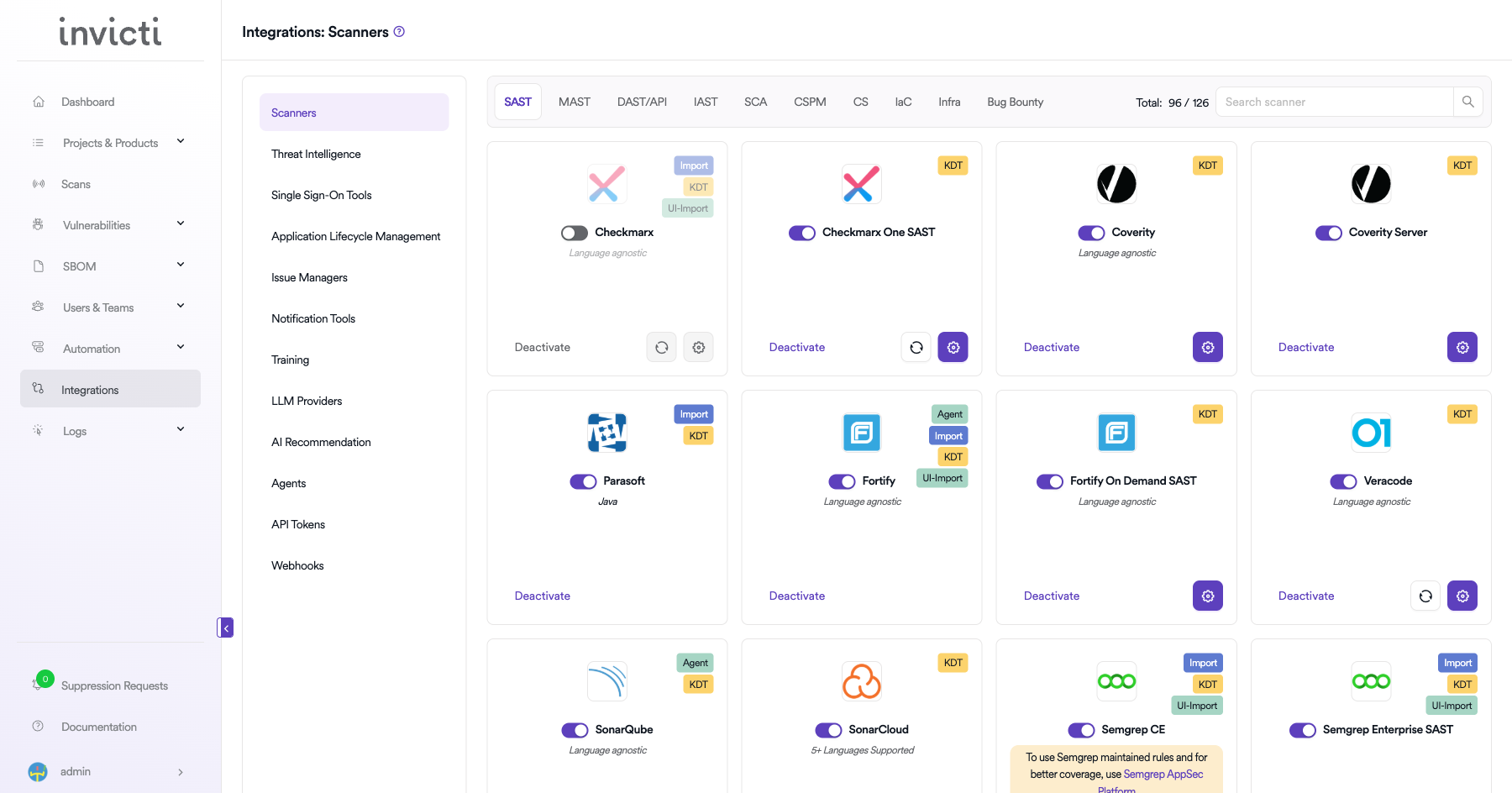
On the Integrations page, you will see the Scanners section with multiple tabs. Click on the SAST tab (it is selected by default).
Step 3: Find and Activate SonarQube
Scroll through the list of SAST scanners to find SonarQube.
-
If SonarQube is not activated, you will see an "Activate" button. Click it to enable the integration.
-
If SonarQube is already activated, you will see a toggle switch in the ON position and a "Deactivate" button, along with a gear icon for configuration.
Note: The scan method badges on the SonarQube card show Agent and KDT, which means scans can be triggered through the Kondukto agent or the Kondukto CLI tool (KDT).
Step 4: Configure Connection Settings
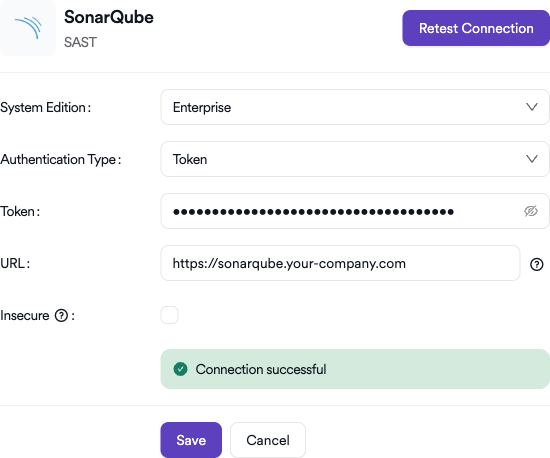
Click on the gear icon on the SonarQube card to open the configuration panel. Fill in the required fields:
-
System Edition: Select your SonarQube edition from the dropdown (e.g., Enterprise, Community, Developer).
-
Authentication Type: Select the authentication method — Token (recommended) or Username & Password.
-
Token: Paste the user token you generated from SonarQube (if Token authentication is selected).
-
URL: Enter your SonarQube instance URL (e.g.,
https://sonarqube.your-company.com). -
Insecure: Enable this checkbox only if your SonarQube instance uses a self-signed SSL certificate.
Step 5: Test the Connection
Click the "Test Connection" button at the bottom of the configuration panel to verify that the provided credentials and URL are correct.
- If the connection is successful, the integration is ready to use.
- If the connection fails, verify your Token and URL values.
- For existing integrations, you can use the "Retest Connection" button at the top of the panel.
Step 6: Advanced Settings (Optional)
Click on "Advanced Settings" to expand additional options:
| Setting | Description | Default |
|---|---|---|
| Allow team leads to scan this instance | Permits team leads to trigger scans using this SonarQube instance | Off |
| Allow team leads to create new instances | Permits team leads to create additional SonarQube instances | Off |
After modifying advanced settings, click "Save Advanced Settings" to apply changes.
Summary
| Step | Action |
|---|---|
| 1 | Navigate to Integrations from the sidebar |
| 2 | Select the SAST tab under Scanners |
| 3 | Find SonarQube and click Activate (if not already active) |
| 4 | Click the gear icon and fill in Token, URL, and optionally Instance |
| 5 | Click Test Connection to verify |
| 6 | (Optional) Configure Advanced Settings for team lead permissions |
How to Create a Scan
After activating and configuring SonarQube, you can create scans from your project's scanner settings.
Navigate to Project Scanners
- Go to your Project page.
- Click on the Settings tab.
- Select Scanners from the left sidebar.
Add SonarQube Scanner
-
In the scanner type dropdown, select SAST.
-
In the scanner dropdown, search for and select SonarQube.
-
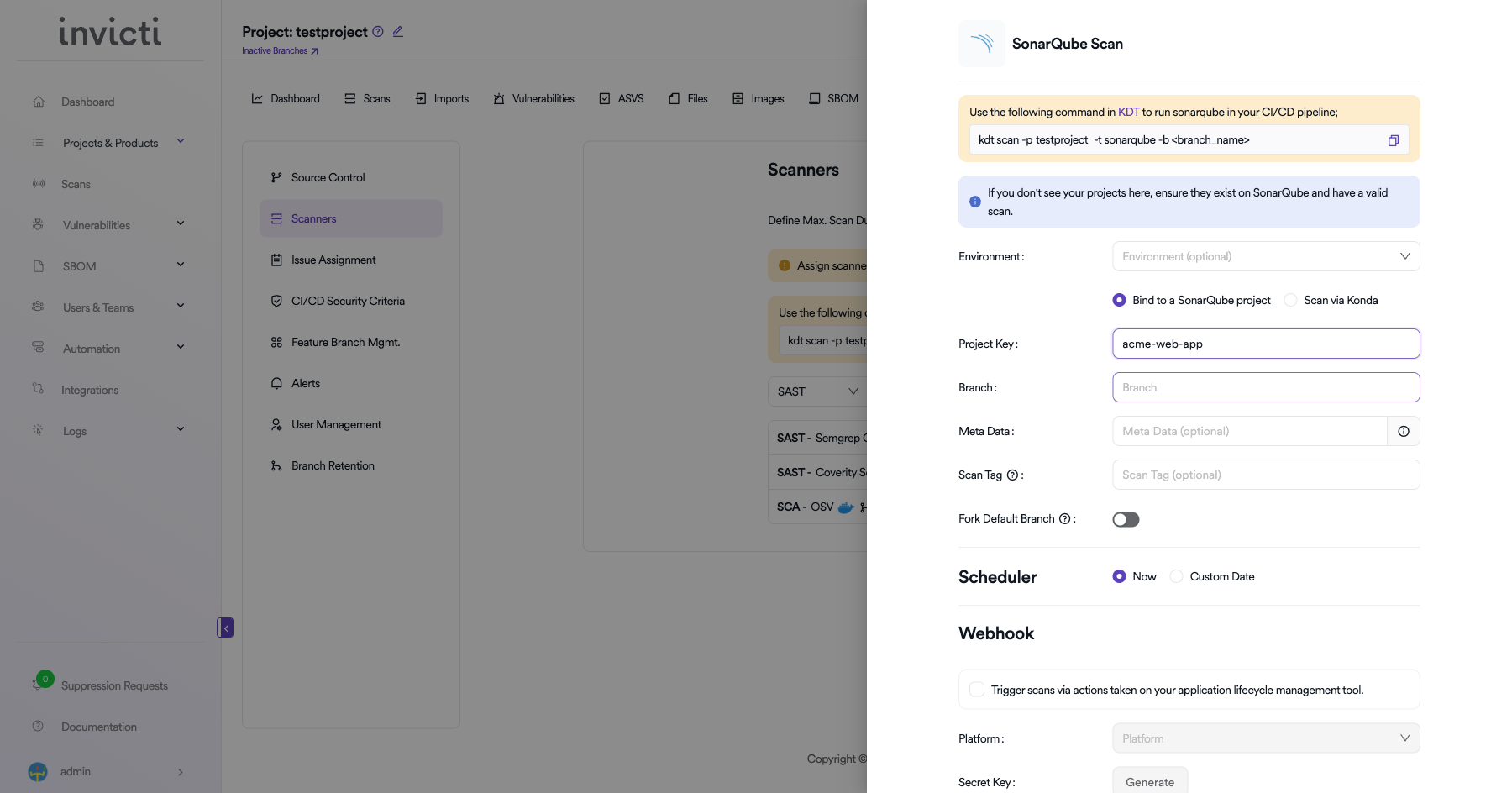
Click the Add button to open the scan configuration drawer.
Scan Configuration Fields
| Field | Description | Required |
|---|---|---|
| Environment | Select the environment for the scan (optional) | No |
| Scan Mode | Choose between Bind to a SonarQube project (use existing SonarQube project) or Scan via Konda (run scan through Kondukto agent) | Yes |
| Project Key | Select the SonarQube project to bind to (shown when "Bind to a SonarQube project" is selected) | Yes (if binding) |
| Branch | Specify the branch to scan | No |
| Meta Data | Additional metadata for the scan (optional) | No |
| Scan Tag | Tag to identify the scan (optional) | No |
| Fork Default Branch | Enable to fork the default branch before scanning | No |
Scheduler
- Now: Run the scan immediately after saving.
- Custom Date: Schedule the scan for a specific date and time.
Webhook (Optional)
Enable webhook to trigger scans via actions taken on your application lifecycle management tool:
- Check the Trigger scans via actions checkbox.
- Select the Platform (e.g., GitHub, GitLab, Bitbucket).
- Click Generate to create a Secret Key for webhook authentication.
KDT Command
You can also trigger SonarQube scans from your CI/CD pipeline using KDT:
kdt scan -p <project_name> -t sonarqube -b <branch_name>Click Save to create the scan configuration.
Troubleshooting
Connection Fails
- Invalid Token: Ensure the token has not expired or been revoked. Generate a new token from My Account > Security in SonarQube.
- Incorrect URL: Verify the URL includes the correct protocol (
https://) and port number if applicable. - SSL Certificate Issues: If using a self-signed certificate, enable the Insecure checkbox in the connection settings.
- Network/Firewall: Ensure the Invicti ASPM instance can reach your SonarQube server. Check firewall rules and proxy settings.
Scan Issues
- No Projects Found: Verify the token has sufficient permissions to list projects in SonarQube.
- Branch Not Found: Ensure the specified branch exists in the SonarQube project and that branch analysis is enabled in your SonarQube edition.
- Empty Results: Confirm that the SonarQube project has completed at least one analysis before importing.
Best Practices
- Use Token Authentication: Token-based authentication is more secure than username/password and allows granular permission control.
- Rotate Tokens Regularly: Set a token expiration policy and rotate tokens periodically.
- Use Dedicated Service Accounts: Create a dedicated SonarQube user for Invicti ASPM integration instead of using personal accounts.
- Match Branch Names: Keep branch names consistent between your repository and SonarQube for accurate tracking.
- Use HTTPS: Always use HTTPS for the SonarQube URL in production environments.
Limitations
- Branch Analysis: Branch analysis requires SonarQube Developer Edition or higher. Community Edition only supports the main branch.
- System Edition: The System Edition dropdown in the connection settings must match your actual SonarQube edition for proper functionality.
- Rate Limits: Large SonarQube instances with many projects may experience slower project listing due to API pagination.
Updated about 3 hours ago